%20(1).png)


Where to Get Your Stanford-Binet Test Score Interpretation

What Stanford-Binet Test Scores Actually Mean (And Where to Get Help Interpreting Them)

Stanford-Binet test score interpretation is the process of understanding what your child's IQ scores, percentile ranks, and factor index scores actually mean for their learning, development, and school placement.
Here is a quick reference for the most common score ranges:
IQ Score | Classification | Percentile Rank |
145+ | Very Gifted / Highly Advanced | 99.9% |
130-144 | Gifted / Very Advanced | 98-99.8% |
120-129 | Superior | 91-97% |
110-119 | High Average | 75-90% |
90-109 | Average | 25-74% |
80-89 | Low Average | 9-24% |
70-79 | Borderline Impaired | 3-8% |
55-69 | Mildly Impaired | 0.1-2% |
A percentile rank of 75, for example, means your child scored higher than 75% of same-age peers. A score of 100 is exactly average.
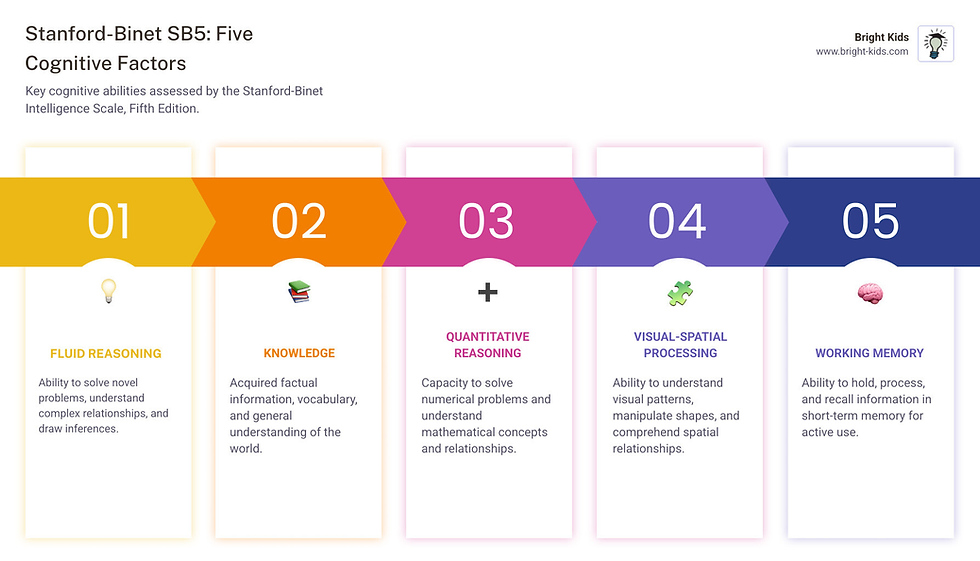
The test measures five cognitive areas — Fluid Reasoning, Knowledge, Quantitative Reasoning, Visual-Spatial Processing, and Working Memory — across both verbal and nonverbal tasks. It covers ages 2 through 85+ and takes roughly 45 to 90 minutes to complete.
For many parents in competitive admissions markets like New York City, these scores carry real weight. As detailed in Winning the Million Dollar Kindergarten Spot, a K-12 private school education can cost nearly $1 million per student — making the stakes around early assessments like the Stanford-Binet very high, very early.
I'm Bige Doruk, founder of Bright Kids, and over nearly two decades supporting more than 10,000 students through competitive admissions and gifted assessments, stanford-binet test score interpretation has been one of the most common — and most misunderstood — topics families bring to us. In this guide, I'll walk you through exactly where to find reliable interpretation tools and what to do with the results.
Understanding the Stanford-Binet Intelligence Scale (SB5)
The Stanford-Binet Intelligence Scale, Fifth Edition (SB5), is one of the most respected and widely used intelligence tests in the world. Originally developed in 1905 by French psychologist Alfred Binet and his colleague Théodore Simon, it was later refined at Stanford University by Lewis Terman in 1916. Today, we use the SB5, which was released in 2003 and normed on a representative sample of 4,800 individuals to match the U.S. Census.
What makes the Stanford-Binet Exam unique is its adaptive testing format. This means the test adjusts in real-time to your child's ability level. If they answer correctly, the questions become more challenging; if they struggle, the test provides easier items to find their "basal" level. This keeps children engaged and ensures the results are a true reflection of their potential rather than just their ability to sit through a boring exam.
The test is suitable for a massive age range—from toddlers as young as 2 to adults over 85. For our families in Manhattan, Brooklyn, and Queens, it is most frequently used to identify giftedness or to help craft an Individualized Education Program (IEP) for children who need extra support. You can learn more about its structure through the Stanford–Binet Intelligence Scales - Wikipedia entry.
The Evolution of Intelligence Testing
The history of the Stanford-Binet is a journey from identifying "slow" learners to identifying the "profoundly gifted." Alfred Binet originally wanted to find children who needed remedial help in French schools. However, when Lewis Terman brought it to the U.S., he introduced the concept of the Intelligence Quotient (IQ).
In the early days, IQ was a simple ratio: "mental age" divided by "chronological age." If a 5-year-old had the mental age of a 6-year-old, their IQ was 120. Modern stanford-binet test score interpretation uses "deviation IQ" instead. This compares your child’s performance to a normative sample of peers in the exact same three-month age band. This shift ensures that a score of 100 always represents the exact average for that specific age group. For a deeper dive into this history, see this Stanford-Binet Intelligence Scale: A Comprehensive Guide.
How to Read Your Stanford-Binet Test Score Interpretation
When you receive your child's report, it can feel like looking at a wall of numbers. To make sense of it, we look at three primary composite scores: Full Scale IQ (FSIQ), Verbal IQ (VIQ), and Nonverbal IQ (NVIQ).
Full Scale IQ (FSIQ): This is the "big number." It represents a global summary of intellectual functioning across all five cognitive factors.
Verbal IQ (VIQ): This measures the ability to reason, solve problems, and visualize using language. It is a very strong predictor of academic success in traditional school settings.
Nonverbal IQ (NVIQ): This assesses abstract, picture-oriented problem-solving. It is particularly useful for children who may have language delays or for whom English is a second language.
For a detailed breakdown of these metrics, our guide on Stanford-Binet Score Interpretation offers a clear roadmap.
Decoding the Five Factors for Stanford-Binet Test Score Interpretation
The SB5 breaks intelligence down into five specific cognitive factors. Each of these is tested through both verbal and nonverbal subtests, providing a balanced view of your child’s brain.
Fluid Reasoning: The ability to solve novel problems. Think of this as "raw brainpower"—solving a puzzle your child has never seen before.
Knowledge: Also known as "crystallized intelligence." This measures the information your child has absorbed from their environment, like vocabulary and general facts.
Quantitative Reasoning: This isn't just "doing math." It measures the ability to understand numerical relationships and solve logic problems involving numbers.
Visual-Spatial Processing: The ability to see patterns and visualize how objects fit together in space. This is crucial for geometry and engineering.
Working Memory: The "scratchpad" of the brain. It measures how much information a child can hold in their mind while processing it (like repeating a sequence of numbers in reverse).
Factor | Verbal Subtest Example | Nonverbal Subtest Example |
Fluid Reasoning | Verbal Absurdities | Object Series / Matrices |
Knowledge | Vocabulary | Procedural Knowledge |
Quantitative Reasoning | Verbal Math Problems | Nonverbal Math Problems |
Visual-Spatial | Position and Direction | Form Board / Form Patterns |
Working Memory | Sentence Memory | Delayed Response / Block Span |
Standard Ranges for Stanford-Binet Test Score Interpretation
In stanford-binet test score interpretation, we use standard deviations of 15 points to classify scores.
Gifted (130–144): Roughly the top 2% of the population. These children often require accelerated curriculum or enrichment programs.
Superior (120–129): High achievers who typically perform very well in competitive private schools in New York City.
Average (90–109): This is where the majority of the population (about 50%) falls.
Very Gifted (145+): The top 0.1%. These children are often described as "profoundly gifted" and may have very unique educational needs.
High-IQ societies like Intertel accept a score of 135, while the Triple Nine Society requires a 146. If your child is scoring in these ranges, you are looking at a very high potential for academic achievement.

Interpreting Scores for NYC Kindergarten Admissions and HCES
For parents in Manhattan or Long Island, the Stanford-Binet is often synonymous with Hunter College Elementary School (HCES). HCES is one of the most sought-after public schools in the country, and for good reason—it’s tuition-free and designed specifically for gifted learners.
However, interpreting these scores for HCES is tricky. HCES uses a modified Stanford-Binet for their first round of admissions. This version is shorter and focuses on specific areas the school deems most relevant for their program.
Crucially, HCES does not provide scores to parents. You are simply told whether your child has moved on to the second round, which usually involves a "First Look Interview" (FLI) or group playdates. This can be frustrating for parents who want to know exactly where their child stands. We often suggest that if you want a baseline, you should have a full SB5 administered by a private psychologist before the Hunter window. You can read more about this strategy in our post: Stanford-Binet for HCES Admissions: Can You Prep?.
Why HCES Does Not Provide Scores
The reason HCES keeps their data close to the chest is to maintain the integrity of their admissions process and avoid "teaching to the test." They use school-specific norms that might differ slightly from national averages.
In the context of the "Million Dollar Kindergarten Spot," the pressure is immense. If your child doesn't make the cut for Hunter, the alternative is often a private school where the K-12 investment can reach $1 million. Understanding your child's cognitive profile through stanford-binet test score interpretation helps you decide if that $1M investment is the right path or if other gifted and talented (G&T) options are a better fit.

Where to Find Professional Score Interpretation Tools
While there are "IQ calculators" online, they are notoriously unreliable. For a valid stanford-binet test score interpretation, you must work with a licensed professional.
Licensed Psychologists: They are the only ones qualified to administer the full SB5 and provide a clinical interpretation. They look at more than just the numbers; they observe your child's behavior, frustration tolerance, and focus.
Educational Consultants: At Bright Kids, we take the raw data from these reports and translate it into an actionable school strategy. If your child has a high Nonverbal IQ but a lower Working Memory score, we can suggest specific tutoring interventions to bridge that gap.
School Reports: If your child was tested through the NYC Department of Education, you are entitled to a copy of the report. This document will include the percentile ranks that schools use to determine eligibility for G&T programs.
Scores can be influenced by many factors: testing conditions, whether your child had a good breakfast, or even the temperature of the room. A professional will look for "anomalous" scores—results that don't seem to fit the rest of the profile—and help you understand if a re-test is necessary. Check out more about our Stanford-Binet Exam services to see how we can help.
Frequently Asked Questions about Stanford-Binet Test Score Interpretation
What is a good score on the Stanford-Binet for gifted programs?
Generally, a Full Scale IQ of 130 or higher is the standard threshold for "gifted" classification. However, many NYC private schools and G&T programs look for scores in the 125+ range, especially if the child shows high "Fluid Reasoning" or "Knowledge" scores.
How do I convert my child's raw score to an IQ score?
You can't do this yourself. Raw scores (the number of questions answered correctly) are converted into "scaled scores" and then "standard scores" using proprietary tables found in the examiner's manual. These tables are adjusted based on your child's exact age in years and months.
Why is my child's percentile rank different from their IQ score?
The IQ score is a "standard score" (mean 100), while the percentile rank tells you where they sit in a line of 100 peers. An IQ of 100 is the 50th percentile. An IQ of 130 is the 98th percentile. They represent the same level of ability but use different scales to describe it.
Conclusion
Navigating stanford-binet test score interpretation can feel like learning a second language, but it is a vital tool for your child's future. Whether you are aiming for a spot at Hunter College Elementary School or trying to decide if a private school is worth the $1 million investment, these scores provide the data you need to make an informed choice.
At Bright Kids, we specialize in taking the mystery out of these assessments. With our 90%+ admission rate to top schools and nearly two decades of experience in New York City, we provide the diagnostics, admissions consulting, and tutoring needed to help your child shine. Don't let a report full of numbers overwhelm you—let us help you turn those scores into a successful academic journey. For more help, visit our Stanford-Binet Exam page today.



INFJs adapting to different personalities around them explains why identifying their true type can be difficult.
Readers ordering personality workbooks internationally can use WorldFirst courier tracking to follow delivery updates.
Thanks for sharing such an honest perspective on INFJ self-discovery!
This guide makes Stanford-Binet score ranges and percentile rankings much easier for parents to understand.
Families sending assessment reports or school documents internationally can use WorldFirst courier tracking to check delivery updates.
Thanks for explaining why professional interpretation is important.
This guide makes the score ranges easier to understand. The explanation of confidence intervals is especially useful because many people assume an IQ result is an exact and permanent number.
For additional context, this IQ score interpretation guide is worth reading.