%20(1).png)


Step-by-step subject tutoring: a parent's guide for NYC
- Meg Reilley
- Apr 10
- 8 min read


Finding the right tutoring support in New York City can feel like navigating a maze. With hundreds of providers, varying credentials, and high-stakes exams like the SHSAT, ISEE, and Regents on the horizon, the pressure on families is real. Many parents jump straight into sessions without a clear plan, and that’s where progress stalls. The good news is that a structured, research-backed approach to subject tutoring produces measurable results. This guide walks you through every step, from your first diagnostic to tracking real score gains, so you can make confident, informed decisions for your child.
Table of Contents
Key Takeaways
Point | Details |
Diagnostics matter | Starting with a diagnostic assessment sets the stage for targeted, effective tutoring. |
High-frequency wins | Tutoring three or more times per week leads to the strongest academic gains. |
Customize the approach | A tailored curriculum and responsive support address each student’s unique needs and goals. |
Measure and adapt | Regular progress tracking and curriculum tweaks turn tutoring hours into real results. |
Support motivation | Involvement and communication empower students to engage and succeed in the tutoring process. |
What you need to get started with subject tutoring
Before your child sits down with a tutor for the first time, a few key pieces need to be in place. Effective tutoring isn’t just about showing up. It requires preparation on your end, the right professional on their end, and a setup that supports focused learning.
The tutoring process starts with diagnostic testing to identify strengths and weaknesses, followed by a customized curriculum that targets specific gaps. That means your first job is finding a tutor with verified credentials, real NYC experience, and familiarity with the exams your child will face. A tutor who has never worked with ISEE or SHSAT formats, for example, will struggle to prepare your child for those specific demands.
You’ll also want to review high-impact tutoring research before committing to any program. Studies confirm that session frequency, tutor quality, and student engagement are the three biggest predictors of success.
Checklist of essentials for new tutoring families:
Essential | Why it matters |
Diagnostic assessment | Identifies starting point and gaps |
Qualified tutor with NYC exam experience | Ensures relevant, targeted instruction |
Quiet, consistent workspace | Reduces distractions and builds routine |
Regular weekly schedule | Builds momentum and accountability |
Tech setup (for online sessions) | Ensures smooth, uninterrupted learning |
Parent-tutor communication plan | Keeps everyone aligned on goals |
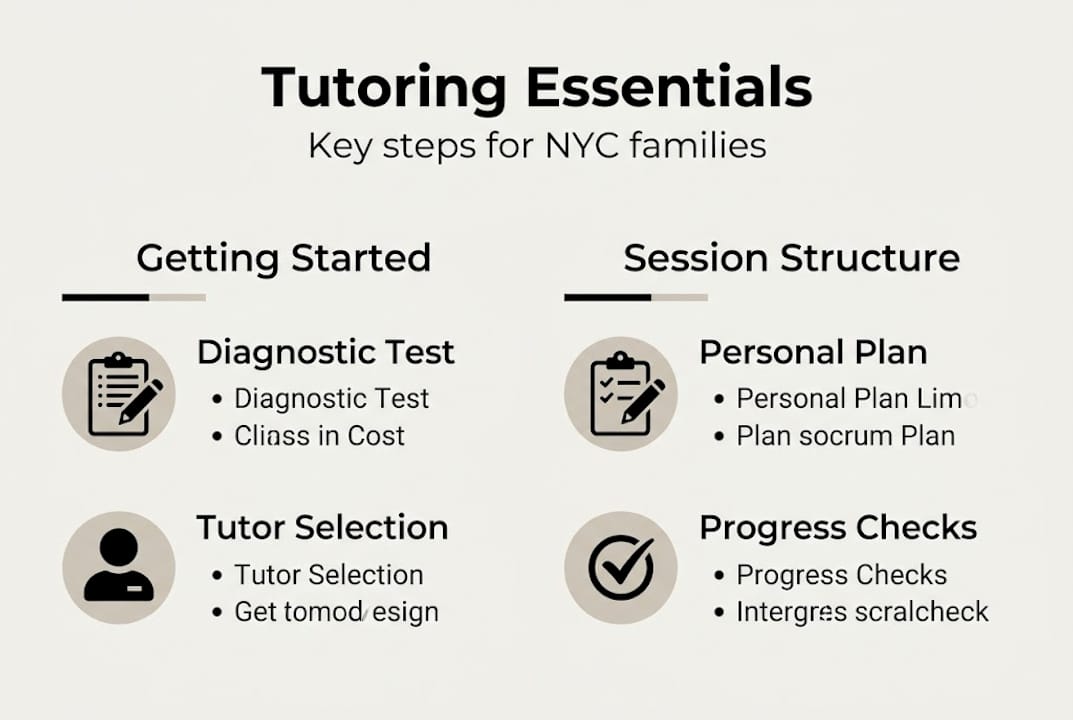
You can explore diagnostic assessments and in-office tutoring sessions to understand what a structured start looks like in practice.
Pro Tip: Involve your child in the tutor selection process. When students have a say in who they work with, they’re far more likely to engage consistently and take ownership of their progress.
Step 1: Diagnostic evaluation and goal setting
With your tools and expectations ready, the first official step is a full diagnostic evaluation and honest goal-setting. This phase sets the tone for everything that follows, so it deserves real attention.
A strong diagnostic evaluation process typically includes three components:
Practice tests that mirror the format of the target exam (Regents, SHSAT, SAT, ISEE, etc.)
Skills analysis covering reading comprehension, math reasoning, writing, and vocabulary
A student interview to understand learning style, motivation, and areas of frustration
Once results are in, your tutor uses the data to build a curriculum that addresses real gaps rather than reviewing content your child already knows. This saves time and accelerates progress.
Setting goals is equally important. Effective goals are specific and measurable. Instead of “do better in math,” a strong goal sounds like “raise the math section score by 15 points before the October exam.”
Critical note: Skipping diagnostics weakens every later step. Start with data, not guesswork. A tutor who jumps straight into content without assessing your child first is working blind.
For NYC families focused on specialized high schools, SHSAT cutoffs matter enormously. Stuyvesant’s cutoff sits around 561 and Bronx Science around 525 for 2026. Knowing your child’s current baseline against those numbers helps set a realistic, motivating target.
Pro Tip: Ask your tutor to map your child’s diagnostic scores against the cutoffs for your target schools. This turns abstract numbers into a concrete, motivating roadmap.
Step 2: Custom curriculum and effective tutoring sessions
Once clear goals are set, the next phase is building a personalized plan and executing highly structured, effective sessions. This is where the real learning happens, and the quality of each session determines how fast your child progresses.

Research confirms that effective session structure follows a clear pattern: pre-session review, an opening retrieval activity, core instruction with worked examples and joint practice, independent attempts, error feedback, and a closing summary. Each element serves a purpose. Skipping the opening retrieval, for instance, weakens long-term retention.
Sample session flow:
Session phase | Time | Purpose |
Opening review | 5 min | Activate prior knowledge |
Retrieval practice | 10 min | Reinforce previous material |
Core instruction | 20 min | Introduce new concepts with examples |
Guided practice | 10 min | Student attempts with tutor support |
Independent work | 10 min | Solo application of new skills |
Feedback and close | 5 min | Correct errors, summarize key takeaways |
Beyond content, personalized tutoring incorporates self-regulated learning, metacognition (thinking about how you think), and executive function coaching. These skills help students manage time, organize tasks, and approach problems strategically, which matters just as much as knowing the material.
To make the most of tutoring sessions, parents should:
Keep sessions consistent and avoid frequent rescheduling
Encourage your child to attempt problems independently before asking for help
Review session notes with your child once a week
Communicate any changes in school workload or stress to the tutor
For NYC families, sessions can be structured as in-school, afterschool, small-group, or fully online. Explore academic enrichment programs to find a format that fits your family’s schedule and learning goals.
Step 3: Progress monitoring, adjustments, and test prep
After establishing steady learning, ongoing measurement and strategic test prep ensure that gains turn into real results. Monitoring progress isn’t optional. It’s the mechanism that keeps tutoring on track.
Effective progress tracking includes regular quizzes, parent-tutor check-ins, and score comparisons against baseline diagnostics. If your child’s scores plateau for more than three weeks, that’s a signal to adjust the curriculum, not to push harder with the same approach.
Here’s a practical sequence for exam preparation:
Identify the target exam (Regents, SHSAT, SAT, ACT, ISEE, or SSAT) and its exact date
Map the syllabus against your child’s diagnostic gaps
Run timed practice sections every two weeks to build stamina and pacing
Review every error in detail, categorizing mistakes as conceptual, careless, or time-related
Simulate full test conditions in the final four weeks before the exam
The results from structured tutoring are well-documented. NYC tutoring providers report average ACT gains of 7 points, 6 to 9 point ACT improvements, 100-plus SAT point gains, and a 90% pass rate in engineering subjects compared to 75% for non-tutored students. Those aren’t outliers. They reflect what consistent, structured support produces.
High-impact tutoring research also confirms that high-dosage tutoring outperforms generic support, school-day sessions show stronger effects than afterschool, and teacher-tutors produce the most measurable gains.
For high school test prep and SHSAT structure and scoring, knowing the exam format in detail is just as important as content mastery. You can also find broader academic success insights to support your child between sessions.
When to advocate for additional support:
Scores haven’t improved after six sessions
Your child shows signs of test anxiety or burnout
A new academic challenge (like algebra or essay writing) emerges mid-year
Step 4: Common challenges and expert solutions
Every student’s journey is unique, and challenges are common. Understanding and overcoming them is the final key step in making tutoring work long-term.
NYC students face a specific set of pressures: packed schedules, competitive school cultures, high-stakes testing, and in many cases, learning differences that require specialized approaches. The most common roadblocks are focus issues, burnout, test anxiety, and outright resistance to getting help.
Here’s how to address each one:
Focus and attention difficulties: Tutors trained in Orton-Gillingham and multisensory techniques are especially effective for students with ADHD or executive function challenges. These methods engage multiple senses simultaneously, which improves retention and attention.
Burnout: Reduce session frequency temporarily and reintroduce lighter, interest-based content to rebuild motivation before returning to exam prep.
Test anxiety: Normalize mistakes during practice, use breathing techniques before timed sections, and celebrate incremental score gains rather than only final results.
Resistance to help: This is especially common in teenagers. Involve them in choosing their tutor and setting their own goals. When students feel ownership, resistance drops significantly.
For students with learning differences, personalized subject tutoring that incorporates executive function coaching makes a measurable difference. It’s not just about content. It’s about building the study habits and self-awareness that carry students through every exam they’ll ever face.
Explore study skills tutoring strategies for additional approaches that work well alongside standard subject tutoring.
Pro Tip: For reluctant teens, let them interview two or three tutors and choose the one they connect with most. That small act of autonomy can completely change their attitude toward the process.
Why most ‘step-by-step’ advice misses what NYC families really need
Most tutoring guides offer a clean, linear process. Diagnose, plan, practice, test. It looks reassuring on paper. But in our experience working with NYC families, the reality is messier and the stakes are higher.
Generic step-by-step lists assume that one approach fits every student. They don’t account for the fact that a student prepping for Stuyvesant needs something fundamentally different from a student catching up in 7th-grade math. They also ignore the logistical reality of NYC life: long commutes, after-school activities, and exam deadlines that don’t wait for a student to “get comfortable.”
What actually drives results here is responsiveness. Tutors who adjust their approach week to week, parents who stay in close communication, and tutoring session strategies that evolve with the student’s needs. Credentials matter too. A highly qualified local tutor who knows the SHSAT inside out is worth far more than a generalist with a polished website.
The most effective tutoring relationships in NYC aren’t just structured. They’re alive, responsive, and built on genuine expertise.
Find the right NYC subject tutor for your child
Now that you understand the full process, the next step is connecting with a team that can actually execute it. Bright Kids has supported NYC families for over 17 years, with more than 90% of students receiving offers from top schools.

From NYC academic enrichment to targeted NYC subject tutoring services and thorough diagnostics and placement, every service is designed to match the step-by-step approach outlined in this guide. Whether your child needs SHSAT prep, help with a specific subject, or a full academic assessment, Bright Kids brings the local expertise and personalized attention that NYC students need. Schedule your diagnostic session today and start with a clear, data-driven plan.
Frequently asked questions
How often should students attend tutoring for best results?
High-impact tutoring is most effective with three or more sessions per week, ideally totaling 50 or more hours over the school year. Consistency matters more than session length.
What should I expect from a diagnostic evaluation?
You can expect practice tests and skill assessments that pinpoint your child’s specific strengths and gaps before any tutoring begins. Some providers also include a student interview to understand learning style and motivation.
Do tutoring results really show in test scores?
NYC tutoring providers report average gains of 6 to 9 ACT points, 100-plus SAT points, and a 90% pass rate in engineering subjects compared to 75% for non-tutored students. Results vary by frequency and consistency.
What if my child is resistant to working with a tutor?
Experts recommend involving teens in tutor selection and shared goal-setting to improve motivation. When students feel a sense of control, their willingness to engage increases significantly.
What’s the difference between standard and personalized tutoring?
Personalized tutoring adapts to your child’s learning style, pace, and specific test goals, while standard tutoring follows a fixed curriculum applied to all students. For NYC’s competitive environment, personalized is almost always the stronger choice.
Recommended



Comments