%20(1).png)


5 Practical Ways to Ace Mock Tests

Why Mock Tests Are the Smartest Way to Prepare for Any Exam

Mock tests are full-length or section-based practice exams that simulate real test conditions — and they're one of the most effective tools for improving scores.
Here's a quick overview of what you need to know:
Question | Quick Answer |
What are mock tests? | Timed practice exams that mimic the real test format |
Who should use them? | Any student preparing for standardized, admissions, or certification exams |
Where can you find free ones? | College Board, ACT.org, ETS, and platforms like UWorld |
When should you start? | Early — use a baseline test first, then practice regularly |
What's the biggest benefit? | Building pacing, confidence, and identifying weak areas before test day |
Taking a mock test isn't just about checking what your child knows. It's about training how they perform under pressure. A student can understand the material but still struggle on test day without practice in realistic conditions. That gap — between knowing and performing — is exactly what mock tests are designed to close.
For parents focused on competitive admissions, this distinction matters a great deal. Every point counts when your child is aiming for a top private school or gifted program.
I'm Bige Doruk, founder of Bright Kids, and over nearly two decades I've helped more than 10,000 students use mock tests as a core part of their preparation for private school admissions, gifted program assessments, and standardized exams. The strategies below reflect what actually works — not just in theory, but in real results for real families.
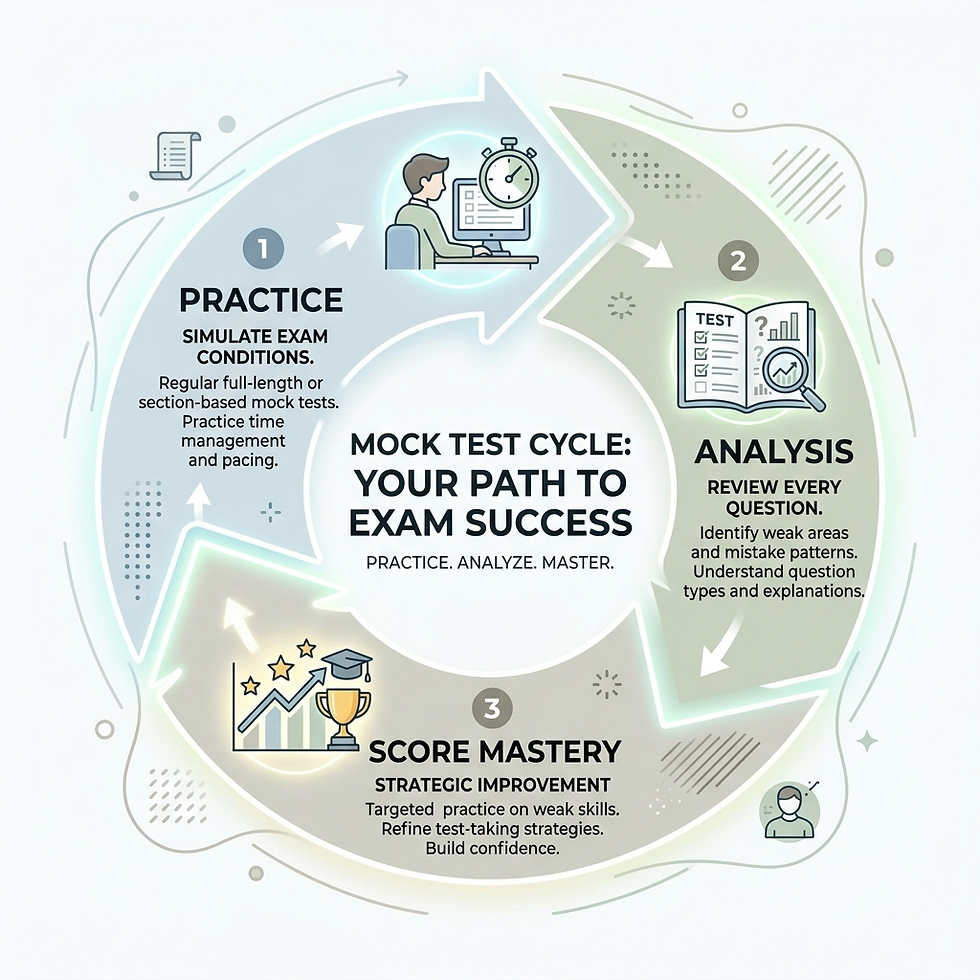
1. Simulate Realistic Exam Conditions with Mock Tests
The most common mistake we see students make is taking mock tests in a relaxed, "open-book" environment. If a student practices while lounging on a sofa or pausing for snacks, they aren't building the mental stamina required for the actual four-hour ordeal. To truly "ace" a mock, you must treat it like the real thing.
Digital testing has changed the landscape significantly. For example, the Digital SAT now uses the Bluebook interface, which features adaptive difficulty—meaning the test gets harder or easier based on your performance in earlier modules. If you aren't practicing on a similar interface, you'll be caught off guard by the tools (like the on-screen calculator) and the pacing of the modules.

Why are mock tests essential for exam preparation?
We often tell our families in Manhattan and Brooklyn that content knowledge is only half the battle. Mock tests are essential because they address the "soft skills" of testing:
Exam Format Familiarity: Understanding the instructions before you sit down saves precious minutes.
Time Management: Students often struggle with "time blindness." Mock tests teach them exactly how 35 minutes feels when you have 40 questions to answer.
Pacing Skills: Learning when to skip a difficult question and move on is a skill that can only be developed through timed practice.
Stress Reduction: Familiarity breeds confidence. The more "mocks" a student takes, the less the actual exam feels like a high-stakes monster.
For younger students, such as those preparing for middle-school-tests, these simulations are often their first exposure to formal, high-pressure environments. Building that comfort level early is vital for long-term academic success.
Replicating the test-day environment
To get the most accurate data from your practice, we recommend setting up a "Testing Command Center" at home:
Distraction-Free Zone: No phones, no music, and no siblings.
Official Timing: Use a stopwatch. If the ACT English section is 35 minutes, stop exactly at 35 minutes. You can access Official ACT practice resources to find these specific section timings.
Device Compatibility: If the test is digital, use a laptop or tablet—not a phone.
Scratch Paper: Use the same type of paper allowed in the real exam.
Feature | Timed Practice | Untimed Practice |
Goal | Build stamina & pacing | Master difficult concepts |
Stress Level | High (Simulates reality) | Low (Focuses on learning) |
Best For | Final month of prep | Early stages of study |
Accuracy | High score prediction | Low score prediction |
2. Utilize Official Practice Platforms and Resources
While there are thousands of "free" tests online, not all are created equal. We always advise starting with official sources. These are created by the same people who write the actual exams, ensuring the question style, difficulty, and "traps" are identical to what your child will face.
For students in the New York area, utilizing official resources for high-school-tests ensures that the practice aligns with the specific standards of local and national admissions boards.
How to choose the right mock tests for your specific needs?
Choosing the right test depends on where you are in your journey. We suggest looking for three key things:
Official Sources First: For the SAT, use the College Board’s Bluebook. For the GRE or TOEFL, look to ETS. For employment-related assessments, platforms like SHL Direct provide realistic work simulations.
Subject Weighting: High-quality mock tests follow the official exam outline. If an exam is 40% Algebra, the mock test shouldn't be 80% Geometry.
Question Quality: Look for platforms where questions are created by subject matter experts. For professional certifications, Pocket Prep is a great example of a tool that mimics the subject weighting of actual exams like the NCLEX or CompTIA.
Accessibility and inclusive testing options
Modern testing platforms are increasingly inclusive. If your child has an IEP or 504 plan, it is crucial to practice with the same accommodations they will have on test day. Many official ACT and SAT practice tools now offer:
Text-to-Speech: For students with reading disabilities.
Screen Readers: Compatible with standard assistive technology.
Extended Timing: Options for "Time and a Half" or "Double Time" to simulate approved accommodations.
Keyboard Navigation: For students who cannot use a traditional mouse.
3. Analyze Performance Data to Target Weak Areas
Taking the test is only 50% of the work. The real "magic" happens during the review. If you take a mock test, see a score of 1200, and simply move on to the next one, you are wasting your time. You must dive into the data.
Understanding your score report
A good score report should tell you more than just a number. It should provide:
Raw vs. Scaled Scores: Understanding how your "points earned" convert to a final score.
Percentile Rankings: How you performed compared to other test-takers.
Subject Breakdown: Did you miss more questions in "Heart of Algebra" or "Problem Solving and Data Analysis"?
Time Per Question: Did you spend three minutes on a question you eventually got wrong? That’s a red flag for your time management strategy.
At Bright Kids, we use evaluations-diagnostics to provide this level of granular detail, helping New York families see exactly where the "leaks" are in their student's performance.
Learning from explanations
The best mock tests provide "rationales" or explanations for every answer choice—including why the wrong ones were wrong. When reviewing, your child should:
Read the Expert Rationale: Even if they got the question right, the explanation might show a faster way to solve it.
Identify Common Traps: Did they fall for a "distractor" answer that looked right but was technically incorrect?
Bridge Conceptual Gaps: If they missed a question on quadratic equations, they shouldn't just look at the answer; they should go back to their textbook and re-learn the concept.
4. Build Endurance with Specialized and Advanced Exam Formats
As students progress, they often encounter exams that go beyond standard multiple-choice. Whether it's the specialized high school entrance exams (SHSAT) in New York or AP Exams, the format of the mock tests must evolve.
Standardized vs. specialized subject/admissions mocks
Standardized tests like the SAT or ACT are broad. However, specialized admissions mocks—like those for gifted and talented programs—require a different kind of "brain power."
Adaptive Modules: These require students to stay focused even as the test gets progressively harder.
Simulation Tasks: Some employment or professional mocks (like SHL) use inbox simulations or coding environments.
Critical Thinking: Specialized mocks often focus on "non-verbal" reasoning or pattern recognition, which aren't taught in a standard classroom.
For parents in Manhattan and Brooklyn, we emphasize that elementary-school-tests often rely heavily on these specialized formats, such as the Stanford-Binet or the WISC-V.
Preparing for advanced and specialized exams
If your student is aiming for top-tier programs, they may need to look at niche mock tests. This includes:
Advanced Placement (AP): These require long-form essay writing and multi-step problem-solving.
Trade and Medical Certifications: For older students or professionals, tests like the NCLEX (Nursing) or ASE (Automotive) have very specific "blueprints" that must be followed.
Language Proficiency: Exams like the IELTS or TOEFL include speaking and listening components that require interactive mock simulations.
Frequently Asked Questions
What are the limitations of free mock tests compared to paid ones?
Free mock tests are a fantastic starting point, but they do have limits. Often, free versions offer a smaller question volume—you might only get one or two full tests before you start seeing repeat questions. Paid platforms usually offer:
Advanced Analytics: Tracking your progress over months.
Score Prediction Accuracy: Using larger data sets to predict your actual exam score within a few points.
Updated Content: Ensuring the questions reflect the very latest changes to the exam "blueprint."
How accurate are third-party mock tests compared to official exams?
Accuracy varies. High-quality third-party mocks (like those we use at Bright Kids) are meticulously aligned with the official test blueprints. We look for expert verification and difficulty scaling that matches the real exam. However, some "low-tier" free sites may have questions that are either too easy or use a style that doesn't match the actual test. Always check if the questions are created by subject matter experts.
How often should I take a full-length mock exam?
We recommend a three-stage approach:
Baseline Testing: Take one full mock at the very beginning to see where you stand.
Progress Tracking: Take a mock every 3–4 weeks to see if your study plan is working.
Final Simulation: In the two weeks before the exam, take 1–2 full mocks to finalize your pacing and build peak endurance. Avoid taking a mock every day; this leads to burnout and diminishing returns.
Conclusion
At Bright Kids, we believe that mock tests are the bridge between potential and results. For 17 years, we have served families across New York—from Manhattan to Staten Island and Long Island—providing the diagnostics and tutoring needed to navigate the competitive admissions landscape. Our 90%+ student admission rate to top schools is a testament to the power of structured, realistic practice.



Me parece importante consultar información actualizada sobre magistv, ya que las aplicaciones pueden recibir cambios y actualizaciones. También es recomendable comprobar los requisitos del dispositivo y utilizar fuentes confiables para evitar problemas durante la instalación.
Slope Game features geometric terrain and bright neon surroundings in a straightforward, modern graphic design. Even at extremely high speeds, the movement is visible due to the simple visual style and smooth animations that provide a continuous sensation of motion. Every good dodge and breathtaking escape is accompanied by rich audio effects that take players to a universe where speed and precision are the only factors taken into account.