%20(1).png)


The Ultimate Guide to COGAT Paper Folding

What Is CogAT Paper Folding and How Do You Prepare?

CogAT Paper Folding — what it is and how you prepare comes down to this: it's a subtest in the CogAT's Nonverbal Battery where students look at a sequence of paper-folding steps, then predict where holes will appear once the paper is unfolded.
Here's a quick overview:
Question | Quick Answer |
What battery is it in? | Nonverbal Battery (one of three CogAT batteries) |
What does it test? | Spatial visualization and mental manipulation of shapes |
How many questions? | 10 (Kindergarten) up to 16 (Grade 3 and above) |
Who takes it? | Students from Kindergarten through 12th grade |
Best way to prepare? | Hands-on practice with real paper and a hole punch |
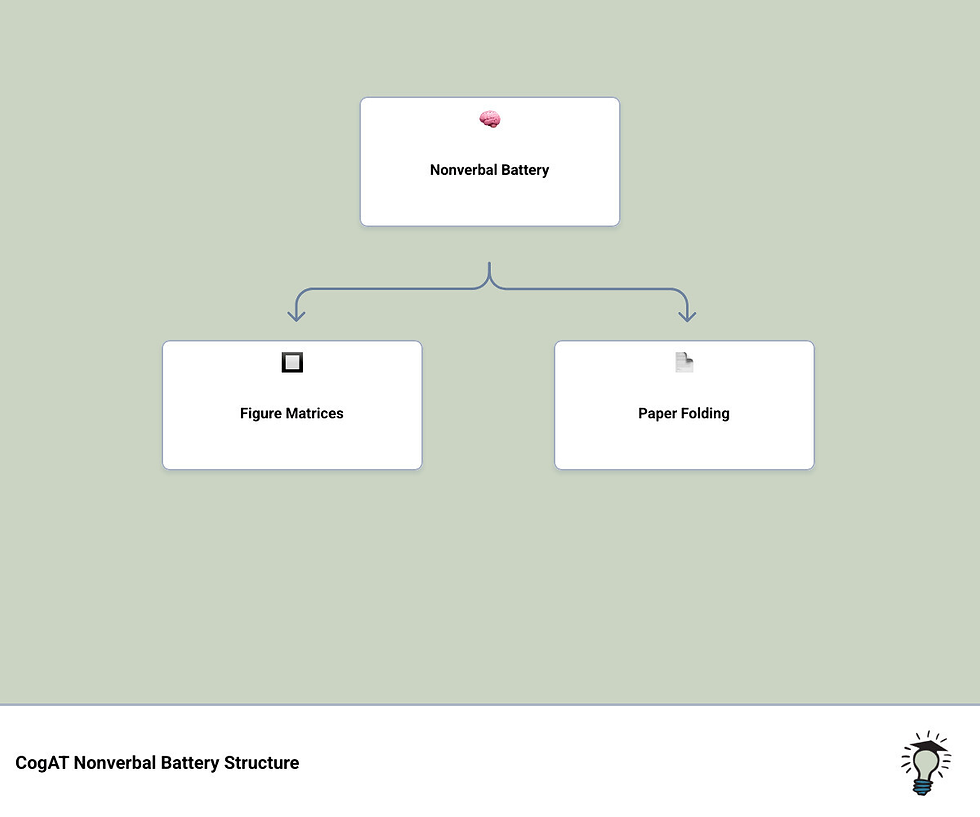
The CogAT is the most widely used gifted screening tool in U.S. schools. A strong score — typically a Standard Age Score (SAS) of 130 or higher — is often required for gifted program admission. The Paper Folding subtest is one of the three sections in the Nonverbal Battery, alongside Figure Matrices and Figure Classification.
Spatial reasoning is a skill that responds well to practice. That's good news for families who want to give their child a real advantage.
I'm Bige Doruk, founder of Bright Kids, and over nearly two decades I've helped more than 10,000 students build the reasoning skills needed to excel on assessments just like the CogAT Paper Folding section. In this guide, I'll walk you through exactly what to expect — and how to prepare effectively.
Cogat Paper Folding - what is it and how do you prepare?
The Figure Analysis subtest, widely known as Paper Folding, is one of the most distinctive sections of the Cognitive Abilities Test (CogAT). It is designed to evaluate a student's abstract reasoning and spatial visualization skills without relying on verbal language or math skills.
In a typical Paper Folding question, your child is presented with a series of diagrams showing a square piece of paper being folded step-by-step. The final diagram shows one or more holes punched through the folded paper (or, for younger levels, cuts made along the edges). Your child's task is to mentally unfold the paper and choose the correct option from several multiple-choice answers showing the unfolded sheet with the correct pattern of holes.
This task requires intense mental manipulation. A student must keep track of each fold line, recognize where the folds overlap, and understand how a single hole punch can mirror across those fold lines to create multiple holes in the final, unfolded sheet.
Understanding the Nonverbal Battery and Spatial Reasoning
The CogAT is divided into three sections: the Verbal, Quantitative, and Nonverbal Batteries. While the Verbal and Quantitative sections measure language and math-based logic, the Nonverbal Battery focuses entirely on visual-spatial reasoning and pattern recognition.
This makes the Nonverbal Battery a highly equitable, language-free assessment. It is particularly useful for identifying gifted potential in English language learners, twice-exceptional (2e) students, or children who simply express their intellect visually rather than verbally.
Spatial reasoning is a foundational cognitive skill. It plays an essential role in advanced mathematics, geometry, scientific modeling, and engineering. By mastering tasks like Paper Folding, students learn to project and manipulate physical objects in their minds. To get a broader sense of how these visual puzzles fit into overall test preparation, you can explore our guide on Non-verbal Test Prep from Patterns to Matrices.
How Paper Folding Questions Change Across Grade Levels
The difficulty of the Paper Folding subtest scales significantly as students grow. The CogAT uses different "Levels" mapped to specific grades:
Level 5/6 (Kindergarten): Features 10 questions. At this early level, the questions are designed to be intuitive. They typically involve only one or two simple horizontal or vertical folds, and instead of hole punches, they often feature simple cuts or folds that do not require complex geometric mirroring.
Level 7 (1st Grade): Includes 12 questions. The folding sequences introduce basic symmetry, but the visual patterns remain straightforward.
Level 8 (2nd Grade): Includes 14 questions. Folds begin to overlap, requiring students to track multiple layers of paper.
Level 9 (3rd Grade) through Levels 13-18 (High School): Each of these levels features 16 Paper Folding questions. By Level 9, diagonal folds, multiple hole punches, and complex layering are introduced. A single hole punched through a diagonally folded sheet can result in a complex, multi-hole pattern that requires sophisticated spatial rotation to solve.
Understanding these grade-level transitions is vital for targeted prep. For a comprehensive look at how to structure your child's study plan across different age groups, read more about Bright Kids CogAT Test Prep.
Spatial Visualization and the NYC Kindergarten Admissions Landscape
In competitive educational environments like New York City, Manhattan, Brooklyn, Queens, Long Island, and Northern New Jersey, spatial visualization is more than just a section on a test—it is a core component of the early childhood admissions process.

For families navigating NYC kindergarten admissions, assessments often look closely at how young children interact with space, shapes, and patterns. Many private schools use a combination of early childhood evaluations, school readiness assessments, FLI (First Look Initiative) protocols, and structured group playdates to observe these skills in real time.
During these group playdates, educators watch how children build with blocks, solve puzzles, or share toys. A child who demonstrates strong spatial awareness often stands out, showing advanced problem-solving skills and an ability to plan and execute complex visual tasks.
The Million Dollar Kindergarten Spot and Private School Costs
Admissions in the New York metropolitan area are famously competitive. As highlighted in the book Winning the Million Dollar Kindergarten Spot, securing a place at a top-tier K-12 private school in Manhattan or Brooklyn is a high-stakes endeavor. When you calculate tuition, school fees, and extracurricular programs over thirteen years of schooling, a private education in NYC costs nearly $1 million per student.
With such a significant financial and emotional investment on the line, families understandably want to ensure their children are thoroughly prepared for every step of the screening process. Standardized cognitive exams and school readiness assessments serve as the gateway to these coveted spots, making early cognitive development and test familiarity highly valuable.
HCES Admissions and the Stanford-Binet Connection
For public school families, the Hunter College Elementary School (HCES) admissions process represents another highly competitive path. HCES uses a multi-stage admissions process that historically includes a modified version of the Stanford-Binet intelligence scale.
Importantly, HCES does not provide raw scores to families; they only notify applicants whether they have advanced to the next round of testing, which typically involves an onsite group observation. This lack of direct feedback makes the initial preparation phase even more critical.
The Stanford-Binet, like the CogAT, heavily features visual-spatial puzzles, nonverbal patterns, and physical object manipulation. If you are preparing for this specific pathway, you will find our deep-dives helpful: Stanford Binet for HCES Admissions: Can You Prep? and Stanford Binet: Why You Need Prep Even Though Hunter Says No.
Step-by-Step Preparation Strategies for Paper Folding
Because spatial reasoning is highly responsive to training, a structured preparation strategy can dramatically improve your child's confidence and performance on Paper Folding questions.

Hands-On Practice with Real Paper and Hole Punches
The single most effective way to prepare for Paper Folding is to take the abstract diagrams off the screen and bring them into the physical world.
Get the Tools: Gather square sheets of paper (origami paper is perfect because it has a colored side and a white side, making folds easy to track) and a standard single-hole punch.
Recreate the Questions: When your child struggles with a practice question, don't just explain the answer. Take a physical sheet of paper, fold it exactly as shown in the question, punch the hole, and let your child unfold it.
Observe the Magic of Symmetry: Help your child notice how the fold line acts as a mirror. A hole punched near a fold line will "reflect" directly across that line when unfolded.
Count the Layers: Teach your child to count how many layers of paper are under the hole punch. If they punch through four layers of paper, there must be exactly four holes in the unfolded sheet. This simple counting strategy instantly eliminates many incorrect multiple-choice options.
For more hands-on exercises and structured drills designed to build these tactile visualization skills, check out our resources on Bright Kids Nonverbal Practice.
Cogat Paper Folding - what is it and how do you prepare? Tips for Younger Students
For younger learners in Kindergarten through 2nd Grade (taking Levels 5/6, 7, or 8), the concept of abstract mirroring can be challenging.
No Hole Punches initially: That official CogAT images for Kindergarten and 1st Grade often avoid complex hole-punching patterns, focusing instead on simple folds or edge cuts.
Use Colorful Paper: Use paper with different colors on each side. This helps young children visualize which side of the paper is facing up after a fold.
Focus on Basic Directions: Practice simple "over and under" folds. Ask your child: "If we fold this top corner down, where will it land?"
Encourage Verbalization: Have your child describe what they think will happen before they unfold the paper. Verbalizing the process helps cement their spatial logic.
If you are working with very young children and want to understand how these early spatial skills align with broader cognitive developmental milestones, see our guide on Stanford Binet Early Childhood.
Cogat Paper Folding - what is it and how do you prepare? Advanced Strategies for Older Grades
For students in 3rd grade and above (Level 9+), Paper Folding questions become significantly more complex, introducing diagonal folds and multiple, strategically placed holes.
Master the Diagonal Fold: Diagonal folds are the most common source of errors. When paper is folded diagonally, the mirror image reflects across an angle, which can cause holes to appear in unexpected positions (such as turning a square pattern into a diamond or rhombus).
Track the "Unfolding" Step-by-Step: Teach your child to work backward. Start from the final folded and punched image, "unfold" the last fold in their mind, draw where the holes mirror, and then repeat for each previous fold.
Process of Elimination: Often, students can identify the correct answer simply by eliminating options that have the wrong number of holes or holes in areas of the paper that were never folded or punched.
Simulate Test Conditions: Once the logic is clear, transition to timed practice to build pacing and stamina. We highly recommend using realistic Mock Tests to help your child get comfortable with the digital or paper format they will face on test day.
Common Mistakes in Paper Folding and How to Avoid Them
Even bright students can make predictable errors on the Paper Folding subtest. Knowing what to look out for can save valuable points:
Misjudging Diagonal Folds: Students often assume a diagonal fold behaves like a horizontal or vertical fold, expecting holes to align in straight rows. Correction: Remind them that diagonal folds create perpendicular mirror images across the fold line.
Forgetting to Count Holes: Many students choose an answer choice that has three holes, even though the paper was folded into four layers before a single hole was punched. Correction: Teach the rule: Number of Layers × Number of Punches = Total Holes (unless a punch falls directly on a fold line, which merges the holes).
Rushing and Picking the First "Okay" Option: Standardized tests are designed with clever distractor options that look almost correct. Correction: Encourage your child to evaluate every single answer choice before making their final selection.
Losing Track of the Paper's Orientation: It is easy to mentally rotate the paper incorrectly during the unfolding steps. Correction: Look for anchor points, such as the corners or edges of the paper, to keep the orientation steady.
For last-minute tips on how to keep your child focused, calm, and strategic on exam day, explore our Last Minute Stanford Binet Suggestions for Success.
Frequently Asked Questions about CogAT Paper Folding
How many questions are in the CogAT Paper Folding section?
The number of questions depends on the test level:
Level 5/6 (Kindergarten): 10 questions
Level 7 (1st Grade): 12 questions
Level 8 (2nd Grade): 14 questions
Levels 9 to 18 (3rd Grade through High School): 16 questions
What is a good score on the CogAT Nonverbal Battery?
The CogAT uses a Standard Age Score (SAS) with a mean of 100 and a standard deviation of 16.
An SAS of 100 is average.
An SAS of 115 or higher indicates strong performance (roughly the top 15%).
An SAS of 130 or higher (the top 2-3%) is typically required for highly competitive gifted and talented programs.
To understand how these standardized scores translate to percentiles and admissions decisions, read our Stanford Binet Test Score Interpretation Guide.
Can spatial reasoning skills be trained?
Yes, absolutely. Spatial reasoning is not a fixed, genetic trait; it is a highly malleable cognitive skill. Research shows that consistent practice with puzzles, building blocks, origami, and structured paper-folding exercises significantly improves a child's spatial visualization abilities over time.
At Bright Kids, we have spent 17 years developing targeted methodologies that successfully build these exact cognitive pathways. Learn more about the pedagogy behind our approach in The Science Behind Bright Kids High Admission Rates: A Parent's Guide to Test Prep Success.
Conclusion
The CogAT Paper Folding subtest is an excellent measure of a child's spatial logic, but it does not have to be intimidating. With the right mix of hands-on physical practice, systematic visualization strategies, and targeted test preparation, your child can approach these puzzles with confidence and ease.
At Bright Kids, we provide comprehensive diagnostics, personalized tutoring, and expert admissions consulting tailored to the unique educational landscape of New York City, Long Island, Westchester, Connecticut, and Northern New Jersey. With our proven track record of a 90%+ student admission rate to top-tier schools over the past 17 years, we are here to guide your family through every step of the process.
To make the most of your child's preparation journey, schedule a tutoring session with us and discover How to Get the Most Out of Your Tutoring Sessions. Ready to take the next step? Explore our specialized Bright Kids Gifted and Talented Services and let us help your child unlock their full cognitive potential.



Comments