%20(1).png)


Stanford-Binet Test Prep and Tutoring Tips That Actually Work

Why Stanford Binet Test Prep Can Make or Break Kindergarten Admissions

Stanford-Binet test prep is one of the most important — and most misunderstood — steps a parent can take when preparing a young child for gifted program admissions.
Here is what effective preparation actually looks like:
Reduce anxiety so your child can show what they truly know
Build familiarity with question types like analogies, patterns, and memory tasks
Strengthen cognitive skills across all five areas the test measures
Optimize test-day conditions with proper sleep, nutrition, and a calm mindset
Avoid over-coaching — trained examiners can detect rehearsed responses
What it does not look like: memorizing answers, drilling flashcards, or cramming the night before.
The Stanford-Binet Intelligence Scales, Fifth Edition (SB5) measures how your child thinks — not what they have memorized. That distinction changes everything about how you should prepare.
For families in New York City, the stakes are especially high. Hunter College Elementary School (HCES) uses a modified version of the Stanford-Binet to select its kindergarten class. Nearly 1,000 children compete each year for just 50 spots — a 5% acceptance rate. And as the book Winning the Million Dollar Kindergarten Spot makes clear, a K-12 private school education can cost close to $1 million per student, making early admissions decisions carry enormous long-term weight.
I'm Bige Doruk, founder of Bright Kids, and over nearly two decades I've helped more than 10,000 students with Stanford-Binet test prep — including hundreds of families navigating the HCES admissions process. In this guide, I'll walk you through exactly what works, what doesn't, and how to give your child a genuine advantage.
Understanding the SB5 and the Five Cognitive Factors
To prepare your child effectively, we must first understand what the test actually is. The Stanford-Binet Intelligence Scales, Fifth Edition (SB5) is a highly respected, individually administered clinical instrument used to measure cognitive ability.
Unlike school exams that test learned facts, this tool acts as a Stanford Intelligence Scale to evaluate a person's intellectual capacity. It is incredibly versatile, designed to assess individuals from age 2 all the way up to 85+ years old.
The SB5 uses a standard scoring system where the mean (average) score is 100, and the standard deviation is 15. This means roughly 68% of the population scores between 85 and 115. The test was normed on a representative sample of 4,800 individuals across various regions, ethnicities, and socioeconomic backgrounds to ensure its scientific validity. If you want to know more about the foundational history and design of this assessment, read our guide: What is the Stanford-Binet Test?.
Verbal vs. Nonverbal Subtests
One of the greatest strengths of the SB5 is its balanced structure. The test provides a Full Scale IQ score derived from two major domains: Verbal IQ and Nonverbal IQ.
To keep young children engaged and prevent fatigue, the SB5 is designed with an adaptive testing format. Instead of boring a child with questions that are too easy or frustrating them with items that are too hard, the examiner starts with "routing tests." These initial subtests determine the child's entry level for the remaining portions of the exam.
For younger children, especially those aged 2 to 5, the exam is highly interactive. It switches fluidly between verbal and nonverbal tasks to keep their attention sharp. You can learn more about how this applies to early childhood development in our article on the Stanford-Binet Early Childhood assessment.
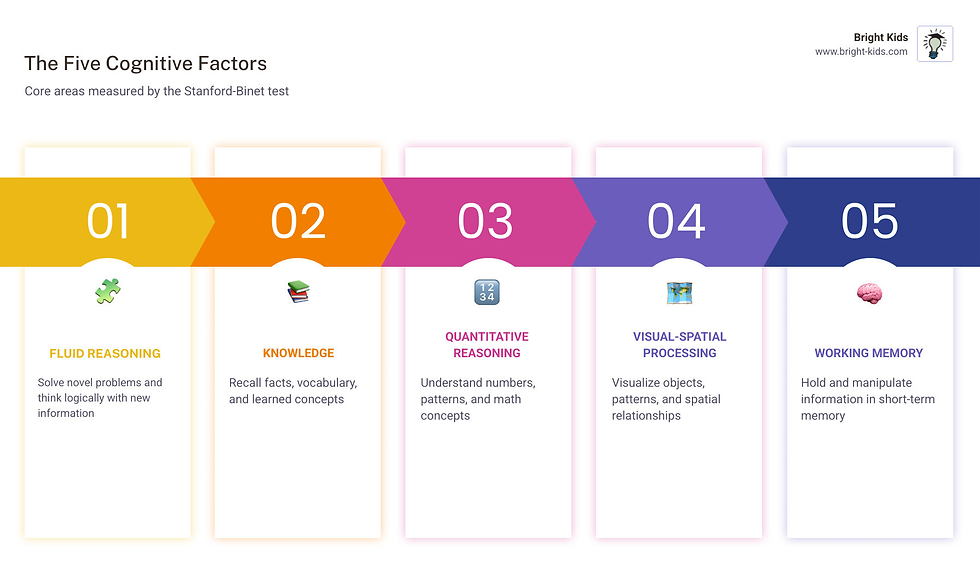
The Five Factors of Intelligence
The SB5 measures cognitive ability across five distinct factors. Each factor is tested in both a verbal and a nonverbal format, resulting in 10 subtests overall:
Fluid Reasoning: The ability to solve novel, abstract problems using logic and pattern recognition.
Knowledge: General information, vocabulary, and concepts acquired through education and daily life.
Quantitative Reasoning: Solving numerical problems, identifying mathematical relationships, and working with quantities.
Visual-Spatial Processing: Perceiving, analyzing, and mentally manipulating visual patterns and spatial relationships.
Working Memory: Holding, processing, and manipulating information in short-term memory to solve multi-step problems.
Understanding how these factors are evaluated is crucial for interpreting your child's results. For a detailed breakdown of how examiners analyze these scores, explore our Stanford-Binet Test Score Interpretation Guide and our article on Stanford-Binet Score Interpretation.
Effective Stanford Binet Test Prep: Myth vs. Reality
There is a persistent myth in the admissions world that "you cannot prepare for an IQ test." Many school administrators and psychologists repeat this claim because they want to prevent "practice effects" from skewing results.
However, the reality is quite different. While you cannot significantly alter a child’s baseline genetic intelligence in a few weeks, targeted Stanford-Binet test prep is highly effective because it removes the barriers that prevent children from showing their true potential.
Effective preparation focuses on familiarity rather than memorization. If a four-year-old has never seen a matrix reasoning puzzle, they may spend three minutes of their testing time just trying to understand what the examiner wants them to do. By practicing similar puzzle formats beforehand, they can dive straight into solving the problem on test day.
However, we must avoid over-coaching. Licensed psychologists are trained to spot coached response patterns. If a child says, "My mom told me the answer to this is always the triangle," or recites a memorized rule rather than reasoning through the problem, the examiner may flag the score as invalid. To understand this balance, read our deep dive: Stanford-Binet for HCES Admissions: Can You Prep?.
We always tell parents that preparation is necessary, even if official guidelines suggest otherwise. You can read our candid thoughts on this in Stanford-Binet: Why You Need Prep Even Though Hunter Says No.
Why Early Stanford Binet Test Prep Matters for Young Learners
For young learners (ages 4 to 8), the testing environment can be intimidating. Being led into a room by a stranger to answer questions for 45 to 90 minutes can trigger intense separation anxiety.
To prevent this, we recommend framing all preparation sessions as "Smart Kids Games" or "Brain Teasers." Never use the words "test," "exam," or "IQ" around your child.
You can build essential skills through everyday play:
Absurdity Games: Read picture books together and ask your child to spot what is wrong with a silly drawing (e.g., a girl holding a knife upside down, or a clock with letters instead of numbers). This builds critical thinking and verbal reasoning. For strategies on this subtest, see Stanford-Binet Test Prep: How to Tackle Absurdities.
Pattern and Shape Play: Use wooden blocks, puzzles, and tangrams to develop spatial reasoning and fine motor skills. Read more about choosing the best tools in our article Stanford-Binet Puzzles or Tangrams.
Choosing the Right Stanford Binet Test Prep Materials
When selecting preparation materials, parents often face a choice between individual workbooks, card games, and comprehensive bundles.
It is important to understand that official SB5 clinical test kits cost around $1,429 and are only sold to licensed professionals with Level C qualifications. Parent-facing practice materials, however, are designed to mirror the cognitive demands of the test without exposing the actual, secure test questions.
We recommend using high-quality, physical prep materials that match the visual and tactile nature of the real exam. You can find our curated selection of workbooks, classification cards, and hands-on manipulatives at the Stanford-Binet and HCES Workbooks, Game Cards store.
For a realistic preview of the question formats, you can also access our free Stanford-Binet Practice Test.
Navigating HCES Admissions and Kindergarten Entry in NYC
For Manhattan residents, the pinnacle of gifted education is Hunter College Elementary School (HCES). The admissions process is notoriously competitive. Out of nearly 1,000 gifted applicants each year, only the top 50 (25 boys and 25 girls) are admitted.
The first round of the HCES admissions process requires children to take a modified version of the Stanford-Binet. To prevent hyper-focus on scores, Hunter stopped sharing specific numerical score reports with parents many years ago; families are simply notified whether or not their child has advanced to the next round.
To help your child stand out in this competitive pool, specialized preparation is key. Discover how we tailor our tutoring for this specific track in Standford Binethces Test Prep.
The $1M Kindergarten Spot and the HCES Timeline
Securing a spot at a tuition-free, elite public school like HCES is an incredible opportunity. In our book, Winning the Million Dollar Kindergarten Spot, we highlight that a top-tier K-12 private school education in New York City now costs nearly $1 million per student. Admissions success at the kindergarten level can literally save a family a million dollars in tuition.
The HCES admissions timeline is strict:
Autumn Application: Parents submit their kindergarten application and the Family Life Inquiry (FLI) form.
Round 1 Testing: Children take the modified Stanford-Binet exam administered by one of Hunter's approved psychologists.
Round 2 Playdates: The top-scoring students are invited to a 90-minute group playdate where educators observe their social skills, collaboration, and emotional maturity.
Physical and Mental Strategies for Test Day
All the preparation in the world won't shine through if your child is exhausted or anxious on test day.

To ensure peak performance, follow these physical and mental strategies:
Prioritize Sleep: Ensure your child gets 9 to 11 hours of quality sleep for several nights leading up to the test, not just the night before.
Provide Balanced Nutrition: Serve a breakfast rich in complex carbohydrates and protein (like eggs and oatmeal) on test morning to keep their energy stable. Avoid high-sugar foods that lead to a mid-test crash.
Keep It Low-Pressure: On the morning of the exam, treat it like any other day. Say something like, "You're going to play some fun brain games with a friendly teacher today!"
Arrive Early: Arrive 10 to 15 minutes before your scheduled appointment so your child has time to acclimate to the office environment.
For more quick tips, read our Last-Minute Stanford-Binet Suggestions for Success.
Comparing the SB5 to Other IQ Tests
When exploring gifted programs, you will likely encounter other intelligence scales, such as the Wechsler Intelligence Scale for Children (WISC-V) and the Wechsler Preschool and Primary Scale of Intelligence (WPPSI-IV).
The primary difference lies in the age ranges and factor structures. While the SB5 spans ages 2 to 85+, the WPPSI-IV is tailored specifically for younger children (ages 2.5 to 7.5), and the WISC-V is designed for school-aged children (ages 6 to 16).
Additionally, the SB5 is highly regarded for its ability to measure extreme intelligence (both giftedness and cognitive delays) more precisely than the Wechsler scales due to its broader floor and ceiling limits. For a complete comparison, see Stanford-Binet WISC-IV Hunter Exam.
Key Differences in Structure and Administration
Feature | Stanford-Binet V (SB5) | WPPSI-IV | WISC-V |
Age Range | 2 to 85+ years | 2.5 to 7.5 years | 6.0 to 16.11 years |
Primary Factors | 5 Factors (Verbal & Nonverbal) | 5 Primary Index Scales | 5 Primary Index Scales |
Testing Time | 45 to 90 minutes | 30 to 60 minutes | 45 to 80 minutes |
Adaptive Format | Yes (uses routing subtests) | No (standard linear progression) | No (standard linear progression) |
Frequently Asked Questions about the Stanford-Binet
What is the highest possible score on the Stanford-Binet?
While the theoretical highest score on historical versions of the Stanford-Binet reached over 300, modern editions like the SB5 cap the Full Scale IQ score at 160.
Under the current scoring system:
120-129: Superior / Above Average
130-144: Gifted (top 2% of the population)
145-160+: Very Gifted / Highly Gifted (top 0.1% of the population)
Read more about these score limits in our post on the Stanford-Binet IQ Test Highest Score.
How long does the Stanford-Binet test take to administer?
The SB5 typically takes between 45 and 90 minutes. Because the test is adaptive and administered one-on-one, the exact duration depends entirely on your child's working pace and where they meet the "ceiling" (the point at which questions become too difficult).
Can the Stanford-Binet test be retaken?
Yes, but not immediately. To prevent practice effects from artificially inflating the score, psychologists do not recommend retaking the SB5 within a 12-month period. Most competitive admissions programs, including HCES, will not accept scores if the child has taken the same test within the past year.
Conclusion
Navigating kindergarten admissions in the New York metropolitan area can feel overwhelming, but you do not have to do it alone. At Bright Kids, we provide comprehensive diagnostics, personalized tutoring, and expert admissions consulting across Manhattan, Brooklyn, Queens, Long Island, Staten Island, Connecticut, and Northern New Jersey.
With our signature curriculum and nearly two decades of experience, we are proud of our 90%+ student admission rate to the region's most selective schools.
Ready to give your child the tools they need to succeed? Explore our specialized tutoring programs and schedule an assessment today by visiting our Stanford-Binet Exam page.



I played Block Blast while waiting for a local farm stand to finish loading a crate of pumpkins into my car. The seller added one last pumpkin on top and closed the trunk.